People with a growth mindset believe:
On the other hand, people with a fixed mindset believe:
Throughout your working life you will face new responsibilities, new technology, new industries, and new competitors. Having a growth mindset means you won't let these challenges set you back. You'll choose to learn, to adapt, and to continue moving forwards. This is incredibly important for your long-term success in whatever work you do.
To embrace and encourage a growth mindset, you need to learn how you best learn. By this we mean do you learn best by:
The list goes on, and whilst you may have already begun to discover what works for you through education, study, or former employment, know this:
You may have heard the phrase before that the path of progress is rarely linear. What this means is that in order to make progress you're going to make mistakes and fail at things.
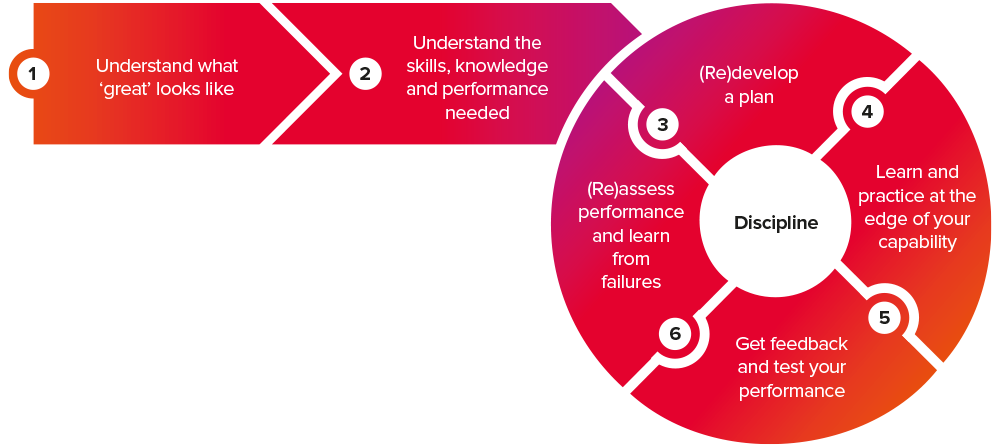
Failure is a great way of learning what doesn't work well and gives you the opportunity to reassess, to learn, and to redevelop a plan. You just need to be disciplined enough to take action.
Take a look at BecomingX's Path of Progress below - an approach to progress that can be applied to many different situations, including reaching a goal at work.
Successful people with a growth mindset consistently get feedback, so they can continue to reassess their performance, redevelop a plan, and practice at the edge of their capability.
Think about a time something didn't go to plan at work, in education or in your personal life. Write down your answers to the following questions.
Personal development means intentionally taking the time to improve your knowledge, skills, and abilities.
One of the most important things to remember is that you are in the driver's seat of your own development. While employers, managers, teachers and mentors can support you, they cannot take responsibility for your growth. That responsibility belongs to you.
People who take ownership of their development are more likely to create opportunities for themselves and achieve their goals. Rather than waiting for someone else to tell them what to learn, they actively look for ways to improve, gather more knowledge, and build their skills.
In the next chapter, we'll explore how you can identify the skills that matter most and take practical steps to develop them.

Zoleka Lisa, Vice President of Corporate Affairs, South African Breweries