

Communication is one of the most important skills in any workplace. Whether you are speaking to a customer, updating your manager, working with colleagues, or writing an email, the way you communicate affects how people see you and how effectively you can do your job.
During your first weeks in your role, demonstrating professional communication can help you make a positive impression, build trust more quickly, and stand out for the right reasons. The good news is, it's a skill that can be improved with practice.
There are three key types of communication in the workplace:
*You can learn more about these in the context of personal brand in module 4
Although professional communication is important in every job, it does not look exactly the same in every workplace.
For example, someone working on a construction site, in agriculture, manufacturing, retail, or hospitality may communicate in a more direct and practical way, often through face-to-face conversations. Someone working in an office environment may spend more time writing emails, participating in meetings, or preparing presentations.
Once you start in your new role, the number one thing to become a better communicator is: look at the people around you. Pay attention to how colleagues speak to each other, how managers give instructions, how messages are written, and how meetings are run. Some will be more formal than others. Notice what seems to work well and adapt to the communication style of your workplace.
The tools below will help prepare you for professional workplace communication ahead of day one. Be aware of them and adopt those that are useful in your setting.
When you communicate at work, it can be tempting to explain everything before getting to the main point. However, busy colleagues and managers often want to know the most important information first.
The Pyramid Principle, developed by consultant Barbara Minto, is a simple way of organising your communication so that your key message is clear and easy to understand. It works for both verbal (e.g. in presentations/meetings) and written (e.g. emails) communication.
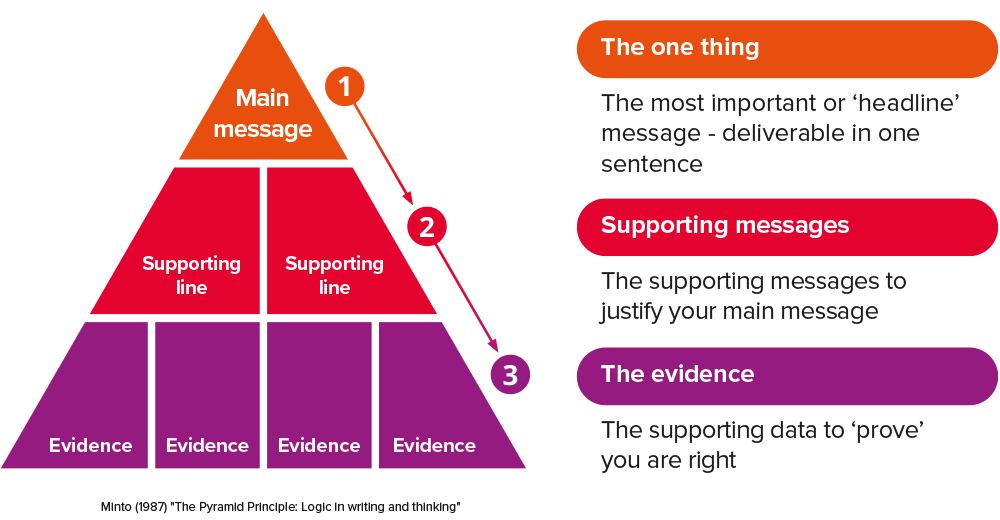
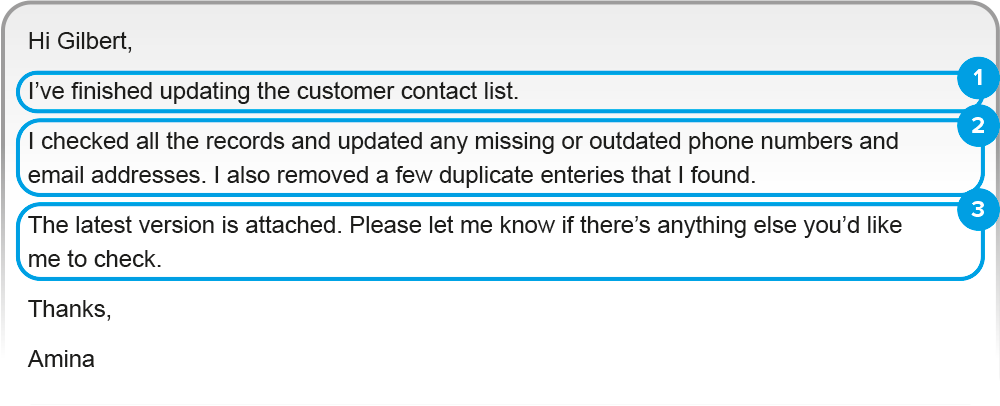
Below is a practical written example. Amina works in administration and is updating her boss, Gilbert. Notice, how she has her key message first, then follows with supporting messages and evidence.
This also works in a conversation. Sipho works at a retailer and is working in the warehouse. He needs to tell his supervisor about a problem with a delivery.
Headline: Boss, one of the crates delivered was heavily damaged.
Supporting message: I've put it aside and reported it to the supplier. It won't impact our stock levels as we already have enough for the next few days.
The evidence: They have confirmed they will be sending a replacement tomorrow and collecting the damaged crate.
When we think about communication, we often jump straight to words. But the truth is, a huge amount of what we 'say' comes through our body language.
If a colleague said to you 'I'm fine', but they're avoiding eye contact, hunched over, arms crossed, would you believe them? Probably not. That's body language speaking louder than words.
Whether you're simply speaking to a customer, or presenting at a meeting, these body language dos and don'ts will help you seem more confident, comfortable, and engaged, even before you've said a word.
| Do | Don't |
|---|---|
| Stand or sit tall | Slouch |
| Make eye contact | Look around the room |
| Use open hand gestures | Cross your arms |
One thing almost everyone struggles with when speaking, especially when feeling under pressure or nervous, is overusing 'filler' words such as:
Some people struggle with these in normal conversation. For others, workplace situations where you're presenting at a meeting or speaking with a customer can cause them to increase. Wherever you fall, getting rid of these is one of the best ways to become a better speaker because they can become incredibly distracting for the people listening to you.
Ask a friend to help you practice removing filler words. Spend 1 minute talking to your friend about a topic of your choice (for example, your favourite thing to do, or your favourite place to visit). You should keep talking for the full minute – they don't respond. Ask them to sharply stick their hand up in the air every time you say one of the above filler words.
This technique can help you become more aware of just how many times you use these words. Once you notice, you can then take action to remove them: slow your speech down or take a pause.
Effective communication works two ways, and understanding others is just as important as making yourself understood. This is why active listening is so important.
What is this?
How can you demonstrate this?
When you first join a new team, often you are asked to introduce yourself.
Write a short 30 second introduction you could use when asked to introduce yourself. If you're struggling with what to write, a simple template to follow is:
Now practice this aloud to yourself, remembering what you have learnt about filler words, and body language.

Malebogo Mpugwa, Chief People Officer, De Beers
